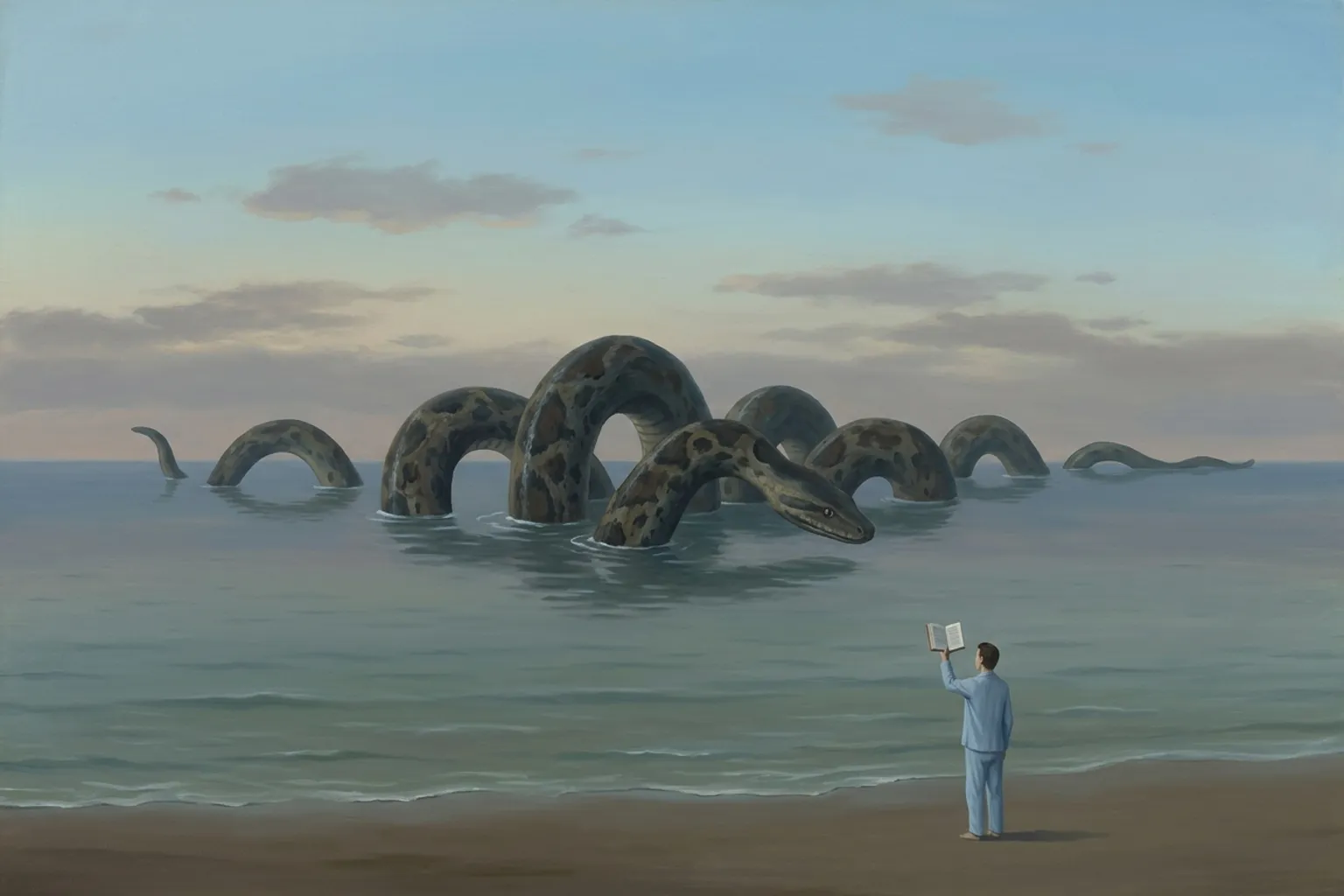
A snake appears in your dream.
You search for its meaning and find ten answers.
Transformation. Betrayal. Sexual energy. Healing. Hidden danger. Rebirth. Fear. Wisdom.
Which one is right?
Possibly none of them.
The problem isn’t that symbols are meaningless. It’s that dreams are personal, and reducing an image to a universal definition removes much of the information that makes it interesting in the first place.
Carl Jung spent decades working with dreams, yet his approach was almost the opposite of a simple dream dictionary. He believed dreams could reveal aspects of the psyche outside ordinary conscious awareness — but understanding them required looking at the dreamer’s associations, circumstances and other dreams. [1]
So instead of asking only:
“What does this symbol mean?”
a Jungian approach asks:
“What does this symbol mean here, in this dream, to this person?”
That small difference changes almost everything.
Do dreams actually mean anything?
We don’t have a definitive scientific answer to why humans dream.
Modern research has proposed numerous functions and mechanisms for dreaming, from memory and emotional processing to models based on the spontaneous activity of brain networks during sleep. [5] There is no scientific consensus that every dream contains a hidden message waiting to be decoded.
There is, however, good evidence for continuity between waking life and dreams.
Dream researchers have found that waking experiences, concerns, relationships and emotional preoccupations tend to be reflected in dream content. Importantly, this isn’t a simple replay of the day. Emotionally significant experiences appear more likely to find their way into dreams than mundane activities. [3] [4]
That’s probably familiar if you’ve kept a dream journal for long.
A difficult conversation might never appear literally. Instead, you dream about missing a train.
A person you haven’t thought about consciously for years suddenly appears.
Your apartment becomes your childhood home.
Your boss somehow becomes your father.
Dreams borrow from waking life, but they rearrange it.
And that’s where interpretation gets interesting.
Freud and Jung didn’t see dreams the same way
(This is the short version. For the full story of Jung’s method, the break with Freud, and how the other schools compare, see Carl Jung and the art of dream analysis.)
Sigmund Freud famously argued that dreams provided access to unconscious wishes and conflicts. He distinguished between the dream as remembered — its manifest content — and an underlying latent content revealed through interpretation.
Jung initially worked closely with Freud, but eventually developed a substantially different view. [2]
One important difference was that Jung didn’t think every dream needed to be reduced to a disguised wish.
He increasingly treated the dream as something worth examining in its own terms.
A strange image wasn’t necessarily camouflage concealing the “real” thought underneath it. The image itself could matter.
And rather than assuming in advance what a symbol represented, Jung placed considerable importance on the dreamer’s own associations.
That distinction remains useful even if you don’t accept Jung’s broader theories of the psyche.
The dream belongs to the dreamer
Imagine two people dream about a dog.
For the first person, dogs are associated with childhood, companionship and safety. Their family dog slept beside them throughout an otherwise difficult childhood.
The second person was attacked by a dog when they were six and remains frightened of them.
Now imagine both dream about a large dog entering their bedroom.
A dream dictionary that says:
Dog: loyalty, friendship and protection
has already failed one of them.
The object is identical.
The association isn’t.
This is why Jungian interpretation begins with context, and why an interpretation grounded in your own journal reads differently from one pulled from a dictionary.
Ask:
- What is this thing to me?
- What memories do I associate with it?
- How did I feel when I saw it?
- What was it doing?
- What happened immediately before it appeared?
- What happened afterward?
A symbol’s general cultural associations can still be useful. But they are better treated as possibilities than answers.
So why talk about dream symbols at all?
Because symbols do have histories.
Snakes, oceans, caves, trees, fire, death, birth, the sun and countless other images have accumulated associations across mythology, religion, literature and art.
Jung was deeply interested in these recurring motifs.
He eventually developed his theory of archetypes: recurring patterns and images that he believed arose from a collective layer of the unconscious shared by humanity.
This is where concepts such as the Shadow, the Persona, the Self and the anima and animus enter Jungian psychology.
Whether Jung’s collective unconscious exists in the form he proposed is not something modern neuroscience has established. [2]
But his interpretive method gives us an interesting middle ground.
You can ask both:
What has this image meant to humans?
and:
What does this image mean to me?
Suppose you dream about descending into a cave.
Across mythology and storytelling, descent underground has often been associated with death, transformation, hidden knowledge and encounters with unknown forces.
That’s interesting context.
But perhaps you spent your childhood exploring caves with your father.
Suddenly your personal association matters enormously.
Neither perspective has to erase the other.
Jung called the process of expanding an image through personal, cultural, mythological and historical associations amplification.
Instead of shrinking the symbol into a definition, you make its context larger.
Dreams may compensate for waking consciousness
One of Jung’s most distinctive ideas about dreams was compensation.
He proposed that dreams sometimes counterbalance the conscious attitude.
If our waking perspective becomes excessively one-sided, the dream may present something that has been ignored or excluded.
A review of Jung’s writings identifies compensation as one of the central ideas running through the development of his dream theory. [2]
Imagine someone who sees themselves as completely independent.
They pride themselves on never needing anyone.
Then they repeatedly dream about being lost and desperately searching for someone to help them.
A Jungian interpretation wouldn’t necessarily conclude:
Being lost means dependency.
Instead it might ask whether the dream presents a side of the person’s experience that their waking identity doesn’t comfortably acknowledge.
Or imagine someone absolutely convinced they’re making the right decision.
Their dreams repeatedly contain hesitation, missed exits and roads leading nowhere.
Again, the point isn’t that the dream magically knows the correct decision.
It may simply be expressing uncertainty that has little room in the person’s conscious story about themselves.
This gives us a useful question to ask after a strange dream:
What attitude does this dream take that I don’t?
Sometimes the answer is nothing.
Sometimes it’s surprisingly obvious.
Start with the feeling, not the symbol
Consider this dream:
I’m standing beside the ocean at night. The waves are enormous.
A traditional dream dictionary might immediately begin interpreting water.
But first ask: how did the ocean feel?
Terrifying? Beautiful? Inviting? Lonely? Powerful? Peaceful?
Did you want to enter it?
Were you desperately trying to escape it?
The exact same image could belong to radically different dreams.
Emotion is often one of the best clues to what deserves attention.
And this has an interesting connection with contemporary dream research. Studies supporting the continuity hypothesis suggest that dreams don’t reproduce waking activities equally; emotional concerns appear particularly important. [4]
So before searching for the meaning of an ocean, snake, house or train, write down how you felt.
That information is easy to lose.
Look at what happens to the symbol
Objects in dreams aren’t static dictionary entries.
They do things.
You don’t simply dream of a key.
You find a key. Lose one. Hide one. Receive one from your mother. Have hundreds of keys but can’t find the correct one. Discover a key that opens a room in your childhood home.
Those are very different dreams.
Likewise:
- A snake bites you.
- You rescue a snake.
- You’re frightened of a snake that turns out to be harmless.
- You become a snake.
If you strip away the action and search only for snake dream meaning, you’ve discarded much of the dream.
A useful interpretation pays attention to relationships:
Who does what to whom?
People in dreams aren’t necessarily about those people
This becomes especially interesting with dream characters.
Suppose an old friend appears in a dream.
The most obvious interpretation is that the dream concerns your old friend.
And sometimes it probably does.
But Jungian interpretation allows another possibility.
A dream character can also represent something you associate with that person.
Perhaps your friend was reckless. Perhaps you envied their confidence. Perhaps you knew them during a particular period of your life. Perhaps you’ve become more like them.
Or perhaps the dream really is about them.
Don’t decide too quickly.
Ask:
Why this person?
And perhaps more importantly:
Why this person now?
One dream is useful. A series is better.
Jung placed particular importance on looking at dreams in series. [1]
This solves one of the biggest problems with dream interpretation: almost any isolated image can support dozens of interpretations.
A house could mean almost anything.
But suppose you keep dreaming about the same house.
In the first dream, you can only enter the ground floor. Months later, you discover stairs. Later still, there’s an entire upper floor you didn’t know existed. Eventually you find someone living there.
Now we have a pattern.
Similarly, perhaps a particular person appears whenever you’re changing jobs. Or trains appear repeatedly during periods when you feel stuck. Or your dreams become filled with enormous buildings whenever your life becomes unusually busy.
Research from a very different theoretical tradition has likewise found repetitive patterns in dream content and continuity with waking emotional preoccupations. [5]
This is one reason dream journaling becomes more interesting with time.
You’re no longer interpreting isolated stories.
You’re observing a system.
If one dream keeps coming back, see Why Do I Keep Having the Same Dream? for a method built around the series.
A simple way to interpret a dream
You don’t need to turn every morning into a psychoanalytic session.
After recording a dream, try five questions.
1. What stands out?
Don’t analyze everything.
Which person, place, object, event or feeling has the strongest charge?
Start there.
2. What do I personally associate with it?
Write down the first things that come to mind.
If it’s a train:
commuting, leaving home, childhood holidays, missing something, Europe, freedom, being trapped on a schedule…
Don’t censor yourself because an association seems stupid.
It might matter precisely because it’s yours.
3. How did I feel?
Record the emotion in the dream rather than how you feel about it afterward.
Those can be surprisingly different.
4. What’s happening in my life right now?
Think beyond yesterday.
Relationships. Decisions. Conflicts. Excitement. Fear. Things you’re avoiding. Things you’re hoping for.
Don’t force a correspondence.
Just put the dream beside your life and see whether anything resonates.
5. Have I dreamed something like this before?
This may be the most useful question of all.
The meaning of tonight’s dream might become clearer six months from now.
Beware of interpretations that are too neat
There’s something seductive about being told:
You dreamed about losing teeth because you’re afraid of losing control.
It produces an immediate feeling of explanation.
But that feeling isn’t evidence that the explanation is true.
A good interpretation should open possibilities rather than prematurely close them.
Try replacing:
“This dream means…”
with:
“Could this dream be exploring…?”
That’s a small linguistic change, but it keeps interpretation where it belongs: as a hypothesis.
Sometimes you’ll find an association that feels deeply relevant. Sometimes you’ll find three competing interpretations. Sometimes a dream will remain completely mysterious.
That’s okay.
You don’t owe every dream an explanation.
Dream dictionaries are starting points, not answer keys
We keep a dream symbol library at Lunar Log.
That might seem contradictory after everything you’ve just read.
It isn’t.
A good symbol guide can show you common psychological, mythological and cultural associations you may not have considered.
If you dream about a bridge, for example, ideas such as transition, connection or crossing between states might be worth exploring.
But perhaps your grandfather built bridges.
That’s why every symbol interpretation should end where your own associations begin.
Use a dream dictionary like you would use a conversation partner.
Let it suggest questions.
Don’t let it tell you what you dreamed.
The meaning may emerge later
Perhaps the strangest thing about keeping a dream journal is that old dreams sometimes become more understandable with time.
You reread something from two years ago and suddenly recognize a pattern you couldn’t have seen then.
The same person had already appeared five times. The same strange building kept returning. A symbol changed just as something in your waking life changed.
Or perhaps nothing becomes clearer at all.
Dream interpretation isn’t a decoding algorithm.
There may never be a definitive answer to what a particular dream “really meant.”
But dreams contain an extraordinary record of the people, places, fears, desires, memories and images occupying our sleeping minds.
Paying attention to that record can be worthwhile without pretending that every image has a secret translation.
So the next time you wake from a strange dream, resist the temptation to immediately ask:
“What does it mean?”
Write it down first.
Notice what you felt.
Follow your associations.
Look for what has appeared before.
Then ask what the dream might be showing you that you weren’t already looking at.
Sometimes the most interesting interpretation isn’t an answer.
It’s a better question.
Lunar Log is a private, local-first dream journal for iOS, Android, and the web. Capture dreams by voice or text, connect recurring people, places and symbols, and build a searchable history that becomes more useful the longer you keep it. It’s free to journal, forever. Get the app.
Sources & further reading
- Jung CG. The Collected Works of C. G. Jung, particularly "On the Nature of Dreams" (vol. 8) and "Symbols and the Interpretation of Dreams" (vol. 18). Princeton University Press.
- Zhu C. Jung on the Nature and Interpretation of Dreams: A Developmental Delineation with Cognitive Neuroscientific Responses. Behavioral Sciences, 2013;3(4):662–675. (PMC)
- Schredl M. Characteristics and contents of dreams. International Review of Neurobiology, 2010;92:135–154.
- Schredl M, Hofmann F. Continuity between waking activities and dream activities. Consciousness and Cognition, 2003;12(2):298–308.
- Domhoff GW, Fox KCR. Dreaming and the default network: A review, synthesis, and counterintuitive research proposal. Consciousness and Cognition, 2015;33:342–353.