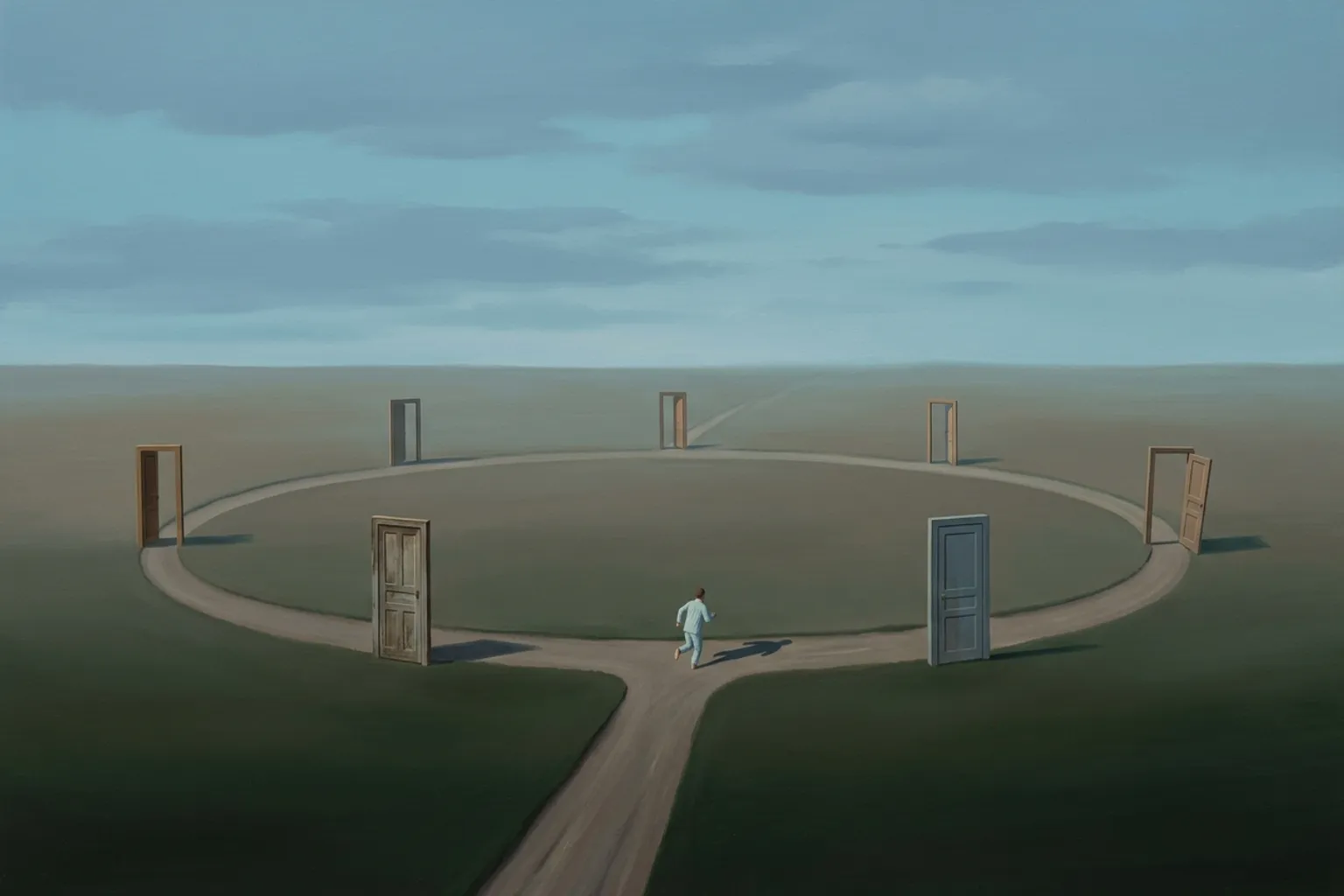
You are running again.
Maybe you don’t know exactly what is behind you, only that you need to get away. You turn down the same street, enter the same building, or reach the same place where the dream always seems to end.
Then, weeks or months later, you’re back.
Recurring dreams can be unusually persistent. Some repeat almost exactly. Others return to the same situation with different details: the house changes, but you are still looking for a room; the exam is different, but you are still unprepared; the person chasing you changes, but you are still running.
It’s tempting to ask what a recurring dream means. But there may be a more useful question:
What is the dream repeating — and what changes each time it returns?
What is a recurring dream?
A recurring dream doesn’t necessarily mean replaying exactly the same dream.
Sometimes it does. You may repeatedly find yourself in the same place, with the same people, going through essentially the same sequence of events.
More often, what repeats is a theme or structure.
You might repeatedly dream about:
- being chased or trying to escape
- arriving somewhere too late
- being unprepared for an exam
- losing control of a vehicle
- discovering rooms in a familiar house
- being unable to find something important
- returning to a place that doesn’t exist in waking life
- seeing the same person
- being unable to speak, run, or call for help
- losing your teeth
- falling
- missing a train or flight
The scenery can change considerably while the emotional structure remains almost identical. [5]
That’s why recurring dreams can be easy to miss if you only compare their plots.
A dream about hiding from an animal and a dream about hiding from a stranger may seem completely different when written down. But both might contain the same pattern:
Something is approaching → I feel threatened → I hide → I nearly get discovered → I wake up.
That pattern may be more interesting than either the animal or the stranger.
Why do dreams repeat?
There isn’t one scientifically established explanation for recurring dreams.
Dreaming itself remains an active area of research, and scientists still disagree about exactly why we dream and what functions dreaming serves. [1]
There is, however, substantial evidence for what researchers call the continuity hypothesis of dreaming: elements of our waking lives — particularly concerns, experiences and emotional preoccupations — tend to appear in our dreams. [1]
Studies have found relationships between waking-life experiences and dream content. People who spend more time engaged in particular activities tend, to some degree, to dream about those activities more often. Emotional involvement also appears to matter. [2]
This doesn’t mean dreams simply replay the previous day.
They don’t.
A disagreement with your boss might become a collapsing building. Someone you haven’t seen for fifteen years might suddenly appear. Your childhood home may somehow contain the kitchen from your current apartment.
Dreams are strange.
But the emotional concerns running through them can be remarkably continuous with waking life.
One longitudinal study, for example, found relationships between psychological well-being and the emotional and interpersonal content of people’s dreams over periods of several years. [3]
So when a dream keeps returning, one possibility is simply that something represented by that dream remains psychologically salient.
That “something” doesn’t necessarily have to be a dramatic unresolved trauma.
It could be a relationship, fear, desire, conflict, transition, responsibility, habit, memory — or simply an emotional pattern that continues to appear in your life.
A Jungian view of recurring dreams
Carl Jung approached dreams somewhat differently.
For Jung, dreams weren’t puzzles with universal answers. He regarded them as expressions of the unconscious that could reveal material neglected, suppressed, or insufficiently recognized by the conscious personality.
From that perspective, repetition becomes particularly interesting.
If a motif continually appears in your dreams, a Jungian approach might ask whether your conscious attitude toward whatever it represents has remained similarly unchanged.
But this is where dream dictionaries can become misleading.
Imagine that you repeatedly dream about a house.
A dictionary might tell you:
House = the self.
That’s neat.
It may even occasionally be useful.
But your house matters more.
Is it your childhood home? A house you’ve never seen? Are you trapped inside it or trying to get in? Does it feel safe? Are there rooms you didn’t know existed? Is it slowly deteriorating? Does the house remain the same while you change?
Two people can repeatedly dream about houses for completely different reasons.
Jung called this process amplification: rather than immediately reducing a dream image to a single definition, you explore its associations, context and connections.
Recurring dreams give you something especially valuable for doing this:
multiple versions of the same material.
Don’t just ask what repeats
Ask what changes.
Suppose you’ve had versions of the same dream for years.
At 22:
You’re being chased through a forest. You hide. They find you. You wake up terrified.
At 27:
You’re being chased through a city. You hide in an apartment. They almost find you, but you escape through a window.
At 34:
You’re being chased again. This time you stop running and turn around.
Calling all three dreams “being chased” loses potentially the most interesting information.
The recurring theme remained.
Your relationship to it changed.
The same can happen with recurring people.
Maybe an old partner appears repeatedly in your dreams. The obvious interpretation would be that you’re still preoccupied with that person.
Perhaps.
But look closer.
In early dreams you’re trying to reach them. Later you’re arguing. Years later they’re simply sitting somewhere in the background. Eventually you dream about them and feel almost nothing.
The symbol remained recognizable while its emotional charge changed.
That’s the sort of pattern you can only see across a series of dreams.
How to investigate a recurring dream
Instead of trying to decode a recurring dream immediately, collect evidence.
Each time it happens, record as much as you can soon after waking. Dream memories fade quickly, and seemingly minor details may become important when you compare several entries later.
Then look across the dreams. This is what the journal’s patterns and insights are built to show: what returns, and how often.
1. What stays the same?
Find the invariant parts of the dream.
It might be:
- a person
- a place
- an object
- an emotion
- a threat
- a task
- a decision
- the ending
- your role in the dream
Try describing the recurring structure in one sentence.
For example:
“I’m trying to get somewhere important, but something always prevents me from arriving.”
That’s often more useful than saying:
“I keep dreaming about airports.”
2. What changes?
Now look for differences.
Perhaps the airport changes. Perhaps sometimes you’re alone and sometimes your family is there. Perhaps you used to panic when you missed the flight, while lately you simply decide to take another one.
Don’t dismiss those differences as random noise.
They may be the most interesting part.
3. What emotion remains?
Dream plots can be bizarre while emotions are surprisingly recognizable.
Research comparing dreaming and waking experience has found continuity in people’s emotional reactions even when dream situations themselves are unrealistic. [4]
So ask: what does this situation feel like?
Fear? Embarrassment? Urgency? Helplessness? Excitement? Grief? Relief? Longing?
Sometimes identifying the recurring emotion makes the connection to waking life much easier to see.
4. When does the dream return?
Dates matter.
Maybe the dream seems random until you notice that it returns:
- during relationship changes
- before major decisions
- when work becomes stressful
- when you’re visiting family
- after seeing a particular person
- during periods of uncertainty
- whenever you’re about to leave something behind
You won’t necessarily notice these connections after two dreams.
After ten, you might.
5. What is happening in your waking life?
Avoid forcing a connection.
Instead, ask what was occupying you around the time of each dream.
Researchers studying dream content have repeatedly found evidence that waking concerns and activities are reflected unevenly in dreams, with emotional involvement appearing to play an important role. [1] [2]
So don’t only ask:
“What happened yesterday?”
Also ask:
“What has been on my mind lately?”
Those are different questions.
Recurring places can be especially interesting
Some people repeatedly return to the same dream locations.
Sometimes these are real places: a childhood home, school, old workplace or neighborhood.
Others seem to have their own geography.
A city that doesn’t exist. A particular hotel. A huge house. A train station. A coastline. A strange version of your hometown.
You may even know where things are in these places despite never having visited them while awake.
Rather than immediately asking what the location symbolizes, start by tracking what happens there.
Who tends to appear? How do you feel when you arrive? Which parts of the place can you access? Does it change over time?
A recurring location can become something like a stage on which different dreams play out.
And after months or years of journaling, its history may become much more revealing than any single appearance.
What if the dream suddenly stops?
That can be interesting too.
A recurring dream may disappear without any obvious reason.
Sometimes people notice that a long-running dream changes shortly before disappearing. They escape. They reach the destination. They confront whatever was pursuing them. A previously inaccessible room opens.
It’s tempting to interpret this as the psyche announcing:
Problem solved.
Reality is probably less tidy.
Dreams change for many reasons, and the disappearance of a recurring dream doesn’t prove that you’ve resolved some hidden psychological conflict.
Still, if a dream you’ve had for years suddenly changes or stops, it’s worth recording what was happening in your life around that time.
The absence of a pattern can itself become part of the pattern.
You don’t need to solve the dream
There’s a subtle trap in dream interpretation.
You can become so focused on finding the correct meaning that you stop actually looking at the dream.
Recurring dreams are particularly resistant to that approach because their significance may lie precisely in their history.
Instead of asking:
“What does being chased mean?”
you might eventually be able to ask:
“Why did I spend five years hiding in these dreams, and why have I recently started fighting back?”
That’s a much more personal question.
And no dream dictionary can answer it for you.
Keep the series, not just the dreams
This is one reason keeping a dream journal becomes more useful with time.
A single dream gives you a snapshot.
A year of dreams gives you something closer to a map.
People return. Places recur. Emotional themes disappear and reappear. Symbols change context. Dreams you thought were unrelated turn out to share almost exactly the same structure.
You don’t need to interpret every dream when you record it.
Sometimes the useful thing is simply to preserve it.
Because the meaning of a recurring dream may not be obvious on the morning you wake from it.
It may only become visible when you meet it again.
And again.
And realize that something has changed.
Related: Why Recurring Dreams Keep Coming Back — a shorter companion piece on recurring dreams as an invitation rather than a repetition.
Lunar Log is a private, local-first dream journal for iOS, Android, and the web. Capture dreams by voice or text, connect recurring people, places and symbols, and build a searchable history that becomes more useful the longer you keep it. It’s free to journal, forever. Get the app.
Sources & further reading
- Schredl M. Characteristics and contents of dreams. International Review of Neurobiology, 2010;92:135–154.
- Schredl M, Hofmann F. Continuity between waking activities and dream activities. Consciousness and Cognition, 2003;12(2):298–308.
- Pesant N, Zadra A. Dream content and psychological well-being: A longitudinal study of the continuity hypothesis. Journal of Clinical Psychology, 2006;62(1):111–121.
- Kahn D. Reactions to Dream Content: Continuity and Non-continuity. Frontiers in Psychology, 2019;10:2676.
- Schredl M. Stability and variability of dream content. Perceptual and Motor Skills, 1998;86(2):733–734.