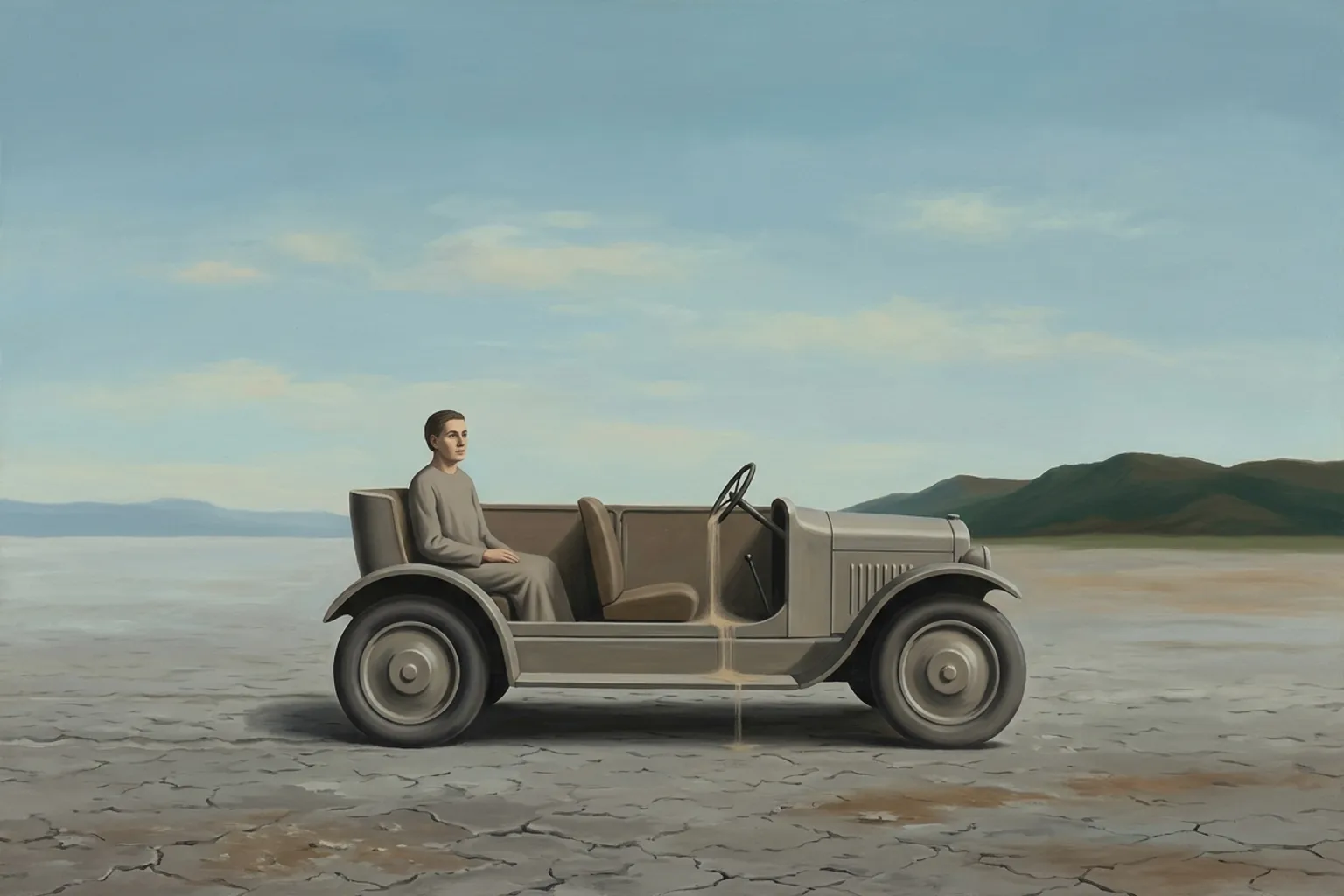
What helplessness tends to mean in a dream
Paralysis, sinking, watching disaster unfold: helpless dreams tend to appear where waking life has taken a decision out of your hands. They are sometimes the mind processing the loss of control, and sometimes a prompt to reclaim what control is actually available.
Helplessness is the emotion of the witness. In a helpless dream the dreamer can usually see everything: the child wandering toward the road, the water rising in the room, the house burning while the phone will not dial. What they cannot do is act. The arms are heavy, the legs are slow, the words come out wrong, and the dream's cruelty is that it lets the dreamer understand precisely what needs doing while withholding the power to do it.
Jung would read this as the ego's encounter with its own limits. Waking life runs on a useful fiction of control: that with enough effort, most things can be fixed. The helpless dream suspends that fiction. It puts the dreamer in front of something, a flood, a war, a loss, that no amount of effort will alter, and asks them to feel what that is like. The feeling is old. It is the feeling of being small in a world of large forces, and most adults have spent years learning not to feel it.
Helplessness dreams tend to arrive when waking life has quietly reproduced that condition. Caring for someone who is ill, watching a child struggle, working inside a system that cannot be changed, waiting on a decision made elsewhere: each of these is a situation of seeing clearly and being unable to act, and the dream renders it at full size. The particular thing the dreamer cannot save in the dream usually names the thing they feel responsible for by day.
There is a compensatory version too. People who carry a great deal of responsibility, who are the ones everyone relies on, often dream of total helplessness, and the dream can be read as the psyche insisting on a truth the day refuses: that they are not, in fact, in charge of everything. Such dreams are exhausting but they are not accusations. They are a reminder that limits exist and that carrying the impossible is a choice.
The way out of a helpless dream, in the dream itself, is often surprising. Dreamers who stop trying to act and simply attend, to the person, to the water, to what is happening, frequently find the dream changes: the child turns around, the water stops, someone else arrives. The dream seems to be asking for presence rather than rescue, and that may be its message for the day as well.
Dreaming you cannot save someone
The child in the road, the friend in the water, the parent who will not listen: failing to save someone is the most painful helpless dream and almost never about a real inability. It belongs to relationships where the dreamer feels responsible for an outcome they do not control, which is most close relationships at one time or another. Ask who, in waking life, you are watching struggle and cannot fix. The dream is not predicting harm; it is naming the weight.
Dreams where you cannot move or your body is too slow
Heavy limbs, running through treacle, hands that fumble every lock: the failing body is helplessness in its purest form, and it has a physical basis, since the sleeping body really is paralysed. But the dream chooses when to make that felt. It tends to appear when the dreamer is being asked to respond to something faster than they can, or when they are holding back a response they know they should make. The slowness is sometimes the dream's picture of hesitation.
Helplessness dreams about money or losing everything
Dreams of being unable to pay, of a wallet gone, of money that will not add up however often it is counted, are helplessness in economic form. They rise in periods of real financial strain but also in periods of feeling unequipped for a demand: a new role, a debt of gratitude, a life that has grown expensive in ways beyond money. Ask what you feel you cannot afford right now, and whether it is measured in currency at all.
Dreams of disasters you can only watch
Standing at the window while the flood comes, watching the tornado from a field with nowhere to go, seeing the war arrive on the news and knowing it is real: the spectator disaster dream describes a life in which large forces are acting on the dreamer from beyond reach. These dreams have become more common in anxious times and they respond to the same treatment: separating what is actually within reach from what is not, and attending to the first.
Questions to ask about this dream
The meaning lives in your dream, not on this page. Before reaching for an interpretation, look at how the feeling actually behaved:
- What did you need to do in the dream, and what exactly stopped you?
- Who or what was at risk, and were you responsible for them in the dream?
- Did anyone else act, or was everyone as stuck as you?
- Did the dream change when you stopped trying?
- What in waking life are you watching and unable to fix right now?
- Are you carrying responsibility for something that is not actually yours to control?
How often does your sleep feel this way?
A page like this can only describe helplessness in general. What matters is your own pattern: how often the feeling comes, what it arrives with, and what was happening in your life on the nights it did. One dream is an anecdote. Thirty tagged dreams are a graph.
Lunar Log is a private, local-first dream journal that tags every dream with how it felt, from this same list of feelings, and charts them over months alongside the people, places and symbols they appear with. It's free on iOS and Android, and open on the web. Get the app.
New to this? Start with how to remember your dreams, or with keeping a dream journal you'll actually use. If a feeling keeps returning in the same dream, read about recurring dreams.