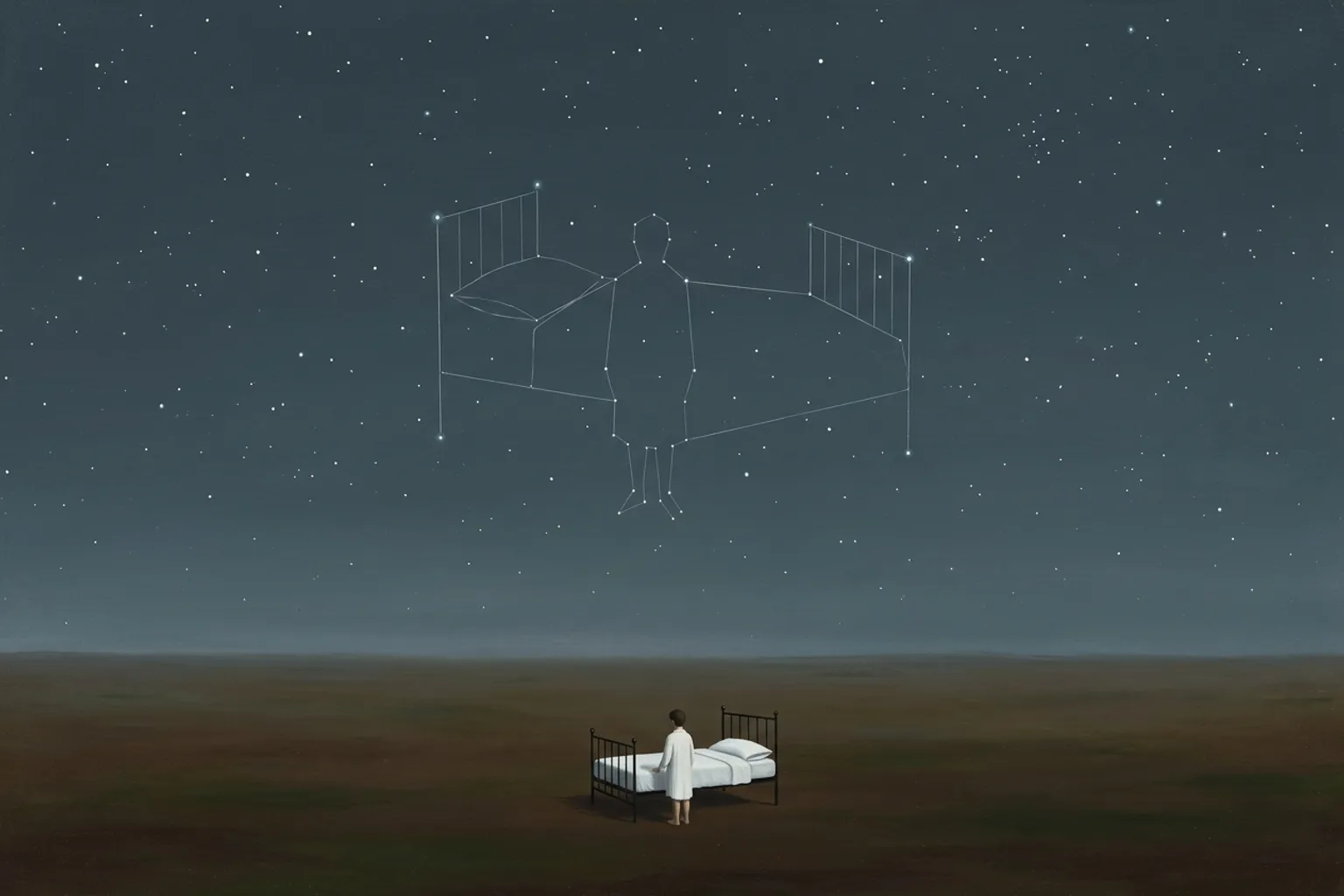
Someone tells you about a dream, then waves it away. “It’s just random. The brain firing off.” It is the most common thing people believe about dreams, and it is not a silly thing to believe. Dreams are bizarre, they contradict themselves, and they are gone by breakfast. If you had to bet, noise looks like the safe bet.
A study published in April 2026 in Communications Psychology, a Nature journal, put that bet to a proper test, and it lost. [1] A team in Italy collected more than 2,000 dreams from 287 adults across four years, scored every one of them on the same scale, and asked whether the content could be predicted from who the dreamer was and what was going on in their life. It could. Not perfectly, and not in the way a dream dictionary would like, but reliably, in ways that survive statistical correction.
Here is what they did, what predicts your dreams, and what that means when you open your own journal.
Where “dreams are random” comes from
The idea has a respectable pedigree. In 1977 two Harvard psychiatrists, Allan Hobson and Robert McCarley, proposed that dreaming begins with more or less random firing in the brainstem during REM sleep, and that the rest of the brain does its best to weave those signals into a story. [2] The hypothesis was aimed at Freud, and it landed. The version that stuck in popular culture was the first half: random signal, meaningless story.
Dream researchers who actually read people’s dreams never quite bought it. Decades of diary studies found continuity between waking life and dreams: the people, places and activities that fill your days turn up at night, roughly in proportion to how much of your life they take, with a few telling exceptions such as reading and working at a computer, which barely appear at all. [3] The trouble was that those studies were small, coded by hand, and usually relied on people remembering their dreams weeks later.
The 2026 study is different in scale and in method. It is, as far as we know, the largest attempt yet to ask the question the hard way.
What the researchers did
The core dataset came from 207 adults, aged 18 to 69, recruited in central and northern Italy between March 2020 and March 2024. [1] They were screened for regular sleep, no sleep or psychiatric diagnoses, and no medication that affects sleep. Then each of them did two weeks of this:
- Every morning, a voice recording of whatever was going through their mind just before they woke, dream or not.
- Once a day, at a random time, a text message saying “record”, prompting them to describe whatever had been in their mind in the last fifteen minutes.
- A wrist actigraph the whole time, to track when they slept and how fragmented it was.
The second item is the clever part. Most dream studies only have dreams. This one had a matched set of waking moments from the same people in the same fortnight, so the researchers could separate what is special about dreams from what is just special about how a given person talks.
Before the fortnight, everyone filled in questionnaires: attitude towards dreaming (six statements, including “dreams are random nonsense from the brain”), trait anxiety, vividness of visual imagery, proneness to mind-wandering, sleep quality, and chronotype. Afterwards, they sat an hour of cognitive tests covering memory, attention, and how many words they use to describe a picture. That last one matters: a verbose person will produce richer reports of everything, and the models corrected for it.
In total they had 1,687 dreams and 1,679 waking reports. A second, independent dataset added 351 dreams from 80 people who kept a diary during the strictest weeks of the Italian COVID-19 lockdown, from 28 April to 11 May 2020. [1]
How you score two thousand dreams
Every report was transcribed, anonymised, and stripped of asides like “I don’t know if this is interesting for you.” Then three large language models each rated every report on sixteen dimensions, from 1 to 9: how visual it was, how much the scene changed, how bizarre, how emotionally intense, how positive or negative, how socially busy, how much the dreamer was in control, how constrained they were, and so on. The median of the three scores was used.
If you are wondering whether an AI can be trusted to read a dream, the researchers wondered too. Four trained human raters scored a subset by hand, and the AI ratings agreed with them about as well as the humans agreed with each other. A separate group of dreamers rated their own dreams, and the AI agreed with them reasonably well too. [1] Alongside the sixteen dimensions, a data-driven method grouped the vocabulary of the reports into 32 topics, from animals and nature to work, food and conflict.
What a dream is made of
The first result is not about individuals at all. It is what happens to experience itself when you fall asleep, measured against the same people’s waking minds. The table shows effect sizes as Cohen’s d, where 0.2 is small, 0.5 medium and 0.8 large. [1]
| Feature | More in | Effect size |
|---|---|---|
| Bizarreness | Dreams | 2.85 |
| Visual detail | Dreams | 1.52 |
| Descriptions of place | Dreams | 1.40 |
| Social interaction | Dreams | 1.40 |
| Scene changes | Dreams | 1.29 |
| Limits on your freedom | Dreams | 0.82 |
| Emotional intensity | Dreams | 0.21 |
| Positive emotional tone | Waking life | 0.49 |
| Awareness of your body | Waking life | 0.73 |
| Awareness of time | Waking life | 1.20 |
| Being in control | Waking life | 1.58 |
| Abstract thought | Waking life | 1.77 |
An effect of 2.85 is enormous; you rarely see one in psychology. Dreams are not slightly stranger than waking thought. They are a different kind of thing.
The authors describe the difference as the difference between a diary and a film. Waking reports are full of thinking, plans and the time of day, told from inside a person who knows where they are and what they are doing. Dreams are scenes: visual, spatial, crowded with other people, cut from one setting to the next, and watched more than acted. You are in control far less often. You are hemmed in far more often. Animals appear in about one dream in five, nature in nearly one in three, and work-related content in a third. [1]
One small finding deserves a mention if you keep a journal. The researchers checked how often the study itself crept into people’s dreams, since laboratory sleep studies famously end up with participants dreaming about electrodes. In this home study it barely happened, and no more in dreams than in waking reports. [1] Two weeks of recording your dreams every morning does not fill your dreams with the recording.
What predicts your dreams: the traits
Now the part that answers the question. After correcting for age, sex, education and verbosity, and after asking specifically for effects that show up in dreams but not in the same person’s waking reports, several stable traits predicted dream content. [1]
1. What you believe about dreams
This was the standout. People who agreed more with statements like “dreams are a good way of learning about my true feelings”, and less with “dreams are random nonsense from the brain”, reported dreams that were more emotionally intense, more bizarre, more visual and richer in place. The same people’s waking reports showed none of this. They also dreamed more about natural landscapes and geometric shapes.
There is an irony here. The people most convinced that dreams are noise are the people reporting the flattest dreams.
The authors are careful about which way this runs, and offer two readings that are not mutually exclusive. One is attention: people who care about dreams notice and report more of what was there anyway. The other is that interest is the visible surface of something deeper, a mind that generates more immersive dreams and is then, naturally, more interested in them. [1] Their earlier work found the same trait predicts whether you wake up feeling you dreamed at all. [5] Either way, it is the same lever that makes dream recall trainable.
2. How much your mind wanders
Proneness to mind-wandering was the strongest single predictor of bizarreness, and it also predicted how often the scene changed. [1] If your attention drifts by day, your dreams jump-cut by night.
This fits a line of research that treats dreaming as an intensified form of mind-wandering, running on much the same brain networks that carry daydreams. [4] The same trait predicts remembering more dreams in the morning. [5]
3. How you sleep
The authors were surprised by how little overall sleep pattern mattered, whether measured by the wrist device or by questionnaire. Two specific links did hold up. People who rated their own sleep as poorer reported more bizarre dreams. And long stretches of light sleep, measured by actigraphy, went with more scene changes. [1] Both fit what we covered in why dreams turn vivid: the later, lighter parts of the night are where the long, shifting, story-like dreams live.
4. Memory and focus
People with better visuospatial memory dreamed about more objects. People less prone to interference on an attention task, the classic test of reading colour words printed in the wrong colour, reported slightly more bizarre dreams. [1] The effects are small, but they are the first hint that the furniture of your dreams depends on the kind of memory you have.
5. Age
Younger participants had more work-related detail in their dreams than in their waking reports. Beyond that, the demographic variables mostly shaped how people talk about everything, dreams and waking life alike, rather than dreams specifically. [1]
What did not show up
Trait anxiety, the vividness of your waking mental imagery, and whether you are a morning or evening person did not emerge as dream-specific predictors in this sample once the corrections were applied. [1] That does not mean they never matter. It means that, in 207 healthy adults over a fortnight, they did not separate from everything else.
What predicts your dreams: your life
Traits are the slow variable. The second half of the study looked at the fast one, using the lockdown dataset as a natural experiment. Compared with dreams collected from other Italian adults after restrictions lifted, dreams during strict lockdown showed: [1]
| Feature | Effect size during lockdown |
|---|---|
| Dramatic, story-like content | 1.09 |
| Work-related content | 0.88 |
| References to time | 0.51 |
| Emotional intensity | 0.50 |
| Fantastical elements | 0.50 |
| Social interaction | 0.48 |
| Limits on your freedom | 0.46 |
| Scene changes | 0.41 |
| The body | 0.36 |
Notice what is missing. References to healthcare, which dominated waking life in spring 2020, did not change at all. [1] People locked in their flats did not dream about hospitals. They dreamed about being unable to move, about work they could not get to, about time, about other people, and the dreams were more intense while they did it. The dream carried the shape of the situation, not its headline.
That echoes a large Italian survey from the same weeks, which found more dream recall and more nightmares, concentrated in the people most anxious and most personally touched by the illness. [6]
Then the researchers followed the main dataset from 2020 to 2024. Over those four years, bizarreness fell, emotional tone turned more positive, intensity fell, and references to constraint faded, in dreams and in waking reports together. [1] Dreams recovered on the same timetable as life did. The authors are explicit that this is correlation, not proof of cause, but it is hard to read a four-year curve like that as noise.
How to read your own dreams with this in mind
Three things follow for anyone with a journal.
Not random is not the same as coded. The study found statistical signal, not a cipher. Nobody in it dreamed a message that meant one thing. What they dreamed had the texture of their mind and the pressure of their circumstances. That is a more useful thing than a secret meaning, and it is what a journal is for. For how meaning works in dreams more broadly, see What Do Dreams Mean?
The signal is in the aggregate. The researchers needed about eight dreams per person, two hundred people and four years to see trait effects. You have one person, so you need time instead. A single dream tells you very little. Thirty dreams over two months start to show you your own baseline: how intense your dreams usually are, how often they change scene, how often you are stuck. Once you know the baseline, the departures from it are the interesting part.
Look for the shape, not the object. The lockdown dreamers did not dream about the virus. Read your journal the way the models scored it. Ask of a dream: how intense was it, how much control did I have, was I constrained, how many times did the scene cut, who was there.
Trying to get to the station, but every street I take loops back to the same square.
Walking through my grandmother’s house, but each room opens onto a beach.
The first scores high on limitation and low on control. The second scores high on scene change and place. Neither is a prophecy. Each is a reading of where you are, in the same sense that your handwriting is. If the first kind starts turning up week after week, that is worth noticing, and Why Recurring Dreams Keep Coming Back covers what to do with it.
Finally, remember the first finding. Taking your dreams seriously predicts richer dreams. Keeping a log reliably raises how many you remember. [7] The study cannot say which comes first, but for you it does not matter. Both directions run through the same door.
What the study cannot tell you
A few honest limits, most of them raised by the authors themselves. [1]
- It measured reports, not dreams. What reaches a voice recorder has already passed through memory and language. The comparison with waking reports helps, since the same filter applied to both, but it cannot separate dreaming from remembering completely.
- The sample was healthy Italian adults with regular sleep and no medication. Whether the same traits predict dreams in people with insomnia, depression or PTSD is an open question.
- The trait effects are real but modest. A high mind-wandering score moves bizarreness by a fraction of a point on a nine-point scale. The state effects, dream versus waking and lockdown versus after, are far larger.
- Everything is correlational and the analysis was not preregistered. The four-year normalisation curve is suggestive, not causal.
None of this rescues the noise hypothesis. It just describes the size of the signal, which is what you would expect from a mind that is yours all night as well as all day.
Frequently asked questions
Are dreams just random brain activity? No. In the largest study of its kind so far, dream content was predicted by stable traits of the dreamer, by their sleep, and by what was happening in their life at the time. [1] The random-firing idea dates from 1977 and described a possible starting point for dreams, not their content. [2]
Do dreams reflect your personality? Some traits, yes. Your attitude towards dreaming, your tendency to mind-wander, and aspects of your memory all predicted dream content in ways that did not show up in the same people’s waking thoughts. [1] Trait anxiety did not, in this sample.
Can stress change your dreams? Yes, and in a recognisable direction. During lockdown, dreams became more intense, more constrained, more social and more dramatic, without becoming literally about the pandemic. [1] [6] See also why dreams feel so emotional.
Why are my dreams so bizarre? The three predictors in this study were a mind that wanders easily, sleep you rate as poor, and long stretches of light sleep. [1] Bizarreness also fell across the population between 2020 and 2024, so a strange spell can simply be a strange time.
Does keeping a dream journal change your dreams? Keeping a log raises how many dreams you remember. [7] Taking an interest in dreams goes with richer, more vivid ones. [1] What it did not do, in this study, was make people dream about the journal.
The next time someone tells you dreams are random, you can tell them about 2,000 dreams, 287 people and four years. Then you can go and read your own, which is where the signal was all along.
Related reading: What Do Dreams Mean?, Why Are My Dreams So Vivid Lately?, Why Dreams Feel So Emotional, and How to Keep a Dream Journal
Lunar Log is a private, local-first dream journal for iOS, Android, and the web. Capture dreams by voice or text before they fade, tag the feeling they left, and see which people, places and patterns keep coming back. It’s free to journal, forever. Get the app.
Sources & further reading
- Elce V, Bontempi G, Scarpelli S, Pedreschi B, Pietrini P, De Gennaro L, Bellesi M, Bernardi G, Handjaras G. Individual traits and experiences predict the content of dreams. Communications Psychology, 2026;4(1):69.
- Hobson JA, McCarley RW. The brain as a dream state generator: an activation-synthesis hypothesis of the dream process. American Journal of Psychiatry, 1977;134(12):1335–1348.
- Schredl M, Hofmann F. Continuity between waking activities and dream activities. Consciousness and Cognition, 2003;12(2):298–308.
- Fox KCR, Nijeboer S, Solomonova E, Domhoff GW, Christoff K. Dreaming as mind wandering: evidence from functional neuroimaging and first-person content reports. Frontiers in Human Neuroscience, 2013;7:412.
- Elce V, Bergamo D, Bontempi G, Pedreschi B, Bellesi M, Handjaras G, Bernardi G. The individual determinants of morning dream recall. Communications Psychology, 2025;3(1):25.
- Scarpelli S, Alfonsi V, Mangiaruga A, et al. Pandemic nightmares: effects on dream activity of the COVID-19 lockdown in Italy. Journal of Sleep Research, 2021;30(5):e13300.
- Aspy DJ. Is dream recall underestimated by retrospective measures and enhanced by keeping a logbook? An empirical investigation. Consciousness and Cognition, 2016;42:181–203.