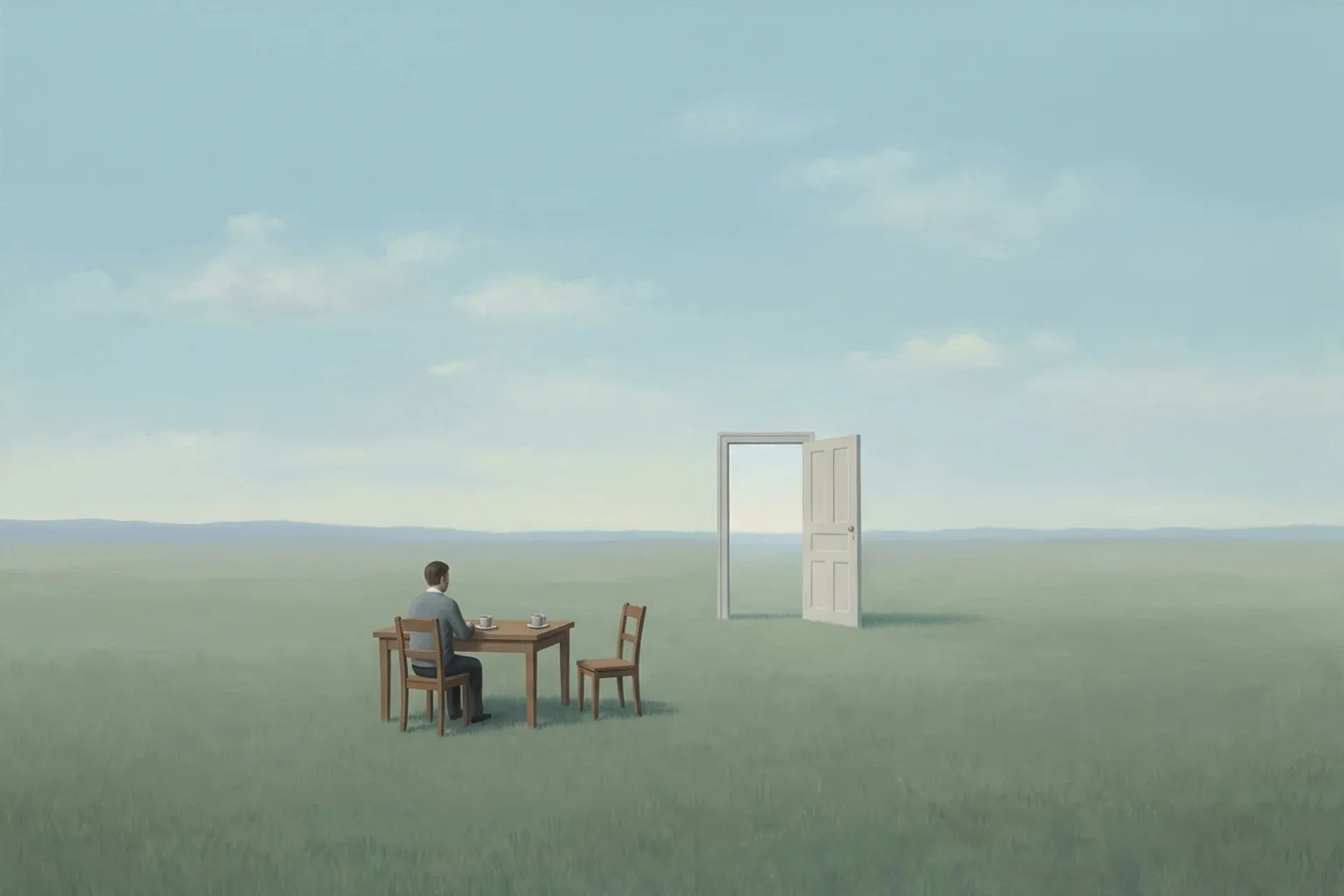
This is a composite dream, written for the page from the shape these dreams most often take. Nobody’s journal is quoted. If it is close to one of yours, that is because it is close to many people’s.
The dream
I’m in the kitchen of the house I grew up in, except the window is in the wrong place and the light outside is the colour of early morning. My father is sitting at the table with a cup of coffee. He died four years ago. In the dream I know that, and it doesn’t seem to matter.
He looks younger than he was at the end. He’s wearing the grey jumper. He says, “You’re doing fine, you know,” in an ordinary voice, like he’s commenting on the weather. I want to ask him a hundred things and I can’t get the words in order. I say something about the garden. He nods as if that’s exactly what he expected me to say.
Then I notice the back door is open and there’s a field behind the house that was never there. He stands up, rinses his cup, and I understand he’s going to walk out into it. I try to say “wait,” but my voice comes out as a whisper. He turns at the door and smiles, and I wake up with my face wet, and for about a minute I’m not sure which one was the dream.
The symbols in it
- Meeting the dead: the returned parent, calm and unremarkable, as if death were a technicality.
- Father: not only the man but the figure — the voice that tells you whether you are doing fine.
- House: the childhood home, slightly wrong, which is how dreams mark a place as the psyche’s rather than the world’s.
- Door: an exit that did not exist, leading somewhere open.
- Losing your voice: the whisper where “wait” should be.
A Jungian reading
Start with what the dream did not do. It did not show him dying again. It did not show him angry, or ill, or as he was at the end. It gave him back at an age when he was simply there, in the kitchen, with a jumper the dreamer could name. Dreams of the dead almost always make this choice, and it is worth taking seriously: the psyche is not replaying the loss. It is restoring the figure.
In Jung’s view the people who shaped us do not leave when they die. They persist as inner figures, and for most of us the father is one of the largest: the voice of judgement and permission, the one who says whether the work is good enough and whether we are. When a father dies, that voice does not fall silent. It loses its outer source and has to be carried from inside, and the years after a parent’s death are, among other things, the slow business of learning to be one’s own parent. The dream is set in the middle of that business.
So listen to what he actually says. “You’re doing fine, you know.” It is not a message from beyond; it is the sentence the dreamer most needs to hear and cannot yet say to themselves in their own voice. The dream borrows his. That it arrives in an ordinary tone, about nothing in particular, is the point: the permission the dreamer is looking for is not ceremonial. It is the kind a father gives over coffee.
Then the two failures of speech. The dreamer cannot get their hundred questions in order, and says something about the garden instead. Later, “wait” comes out as a whisper. Both are the dream being honest about grief: what was never asked, and the wish to hold on a little longer, which the body can’t quite voice. The garden is not a failure, though. It is the dreamer reaching for the shared, daily thing, and he nods because that was always the real conversation.
The open door and the field are the dream’s answer to the whisper. There was no field behind that house. It is the dream extending the world, and he walks into it without hurry after rinsing his cup, the most domestic gesture in the whole scene. Read archetypally, this is the father being released: not banished, not lost, but allowed to go somewhere open while the house, the dreamer’s own psyche, remains. The smile at the door is the dream’s tone, and the tone is the most reliable thing any dream gives you. This one is not frightened. It is tender, and a little final.
The tears on waking, and the minute of not knowing which world was the dream, are the two worlds briefly overlapping. That is what dreams of the dead are for.
Another way to read it
The plainer reading is just as valid. Four years is the distance at which grief changes texture: the acute part is over, and what is left is the ache of small absences, the jumper, the coffee, the things said about the garden. The dream may simply be that ache finding a shape. People tend to dream of a dead parent when something in waking life would have been told to them, a decision, a worry, a piece of news, and the dream is the telling, with the expected answer supplied.
It is also worth asking what happened the day before. A photograph, a song, a date on the calendar, or someone else’s father at a table can call a dream like this up without any deeper work to do. That does not make it less meaningful, only less mysterious.
Neither reading requires the dreamer to decide whether he was “really” there. The dream works the same either way.
Questions to ask about your own version
- How old was he in the dream, and why that age? The psyche chooses.
- What did he actually say? Write it down word for word before it fades; it is usually the most important line.
- What did you say, or fail to say? Was there a question you have carried since he died?
- What was the feeling on waking: relief, grief, guilt, peace? The feeling is the reading.
- Where was the dream set, and what was wrong about the place?
- Has he appeared before? These dreams change over the years, and the changes are the story.
What this looks like in a journal
A reading like this one can only take a dream on its own. In a journal, a dream of your father arrives somewhere: a particular night, the anniversary it landed near, the dreams it followed, the last time he appeared and what he said then. Over months, those visits form a line, and the line is where interpretation stops being a guess.
Lunar Log is a private, local-first dream journal that keeps that history for you and notices what returns: the people, the places, the symbols, the feeling they arrive with. The dream above would have been three taps to capture before it faded. It is free on iOS and Android, and open on the web. Get the app.
If dreams of a lost parent are frequent and distressing rather than tender, that is worth talking about with someone. Grief has no schedule, and neither do its dreams.