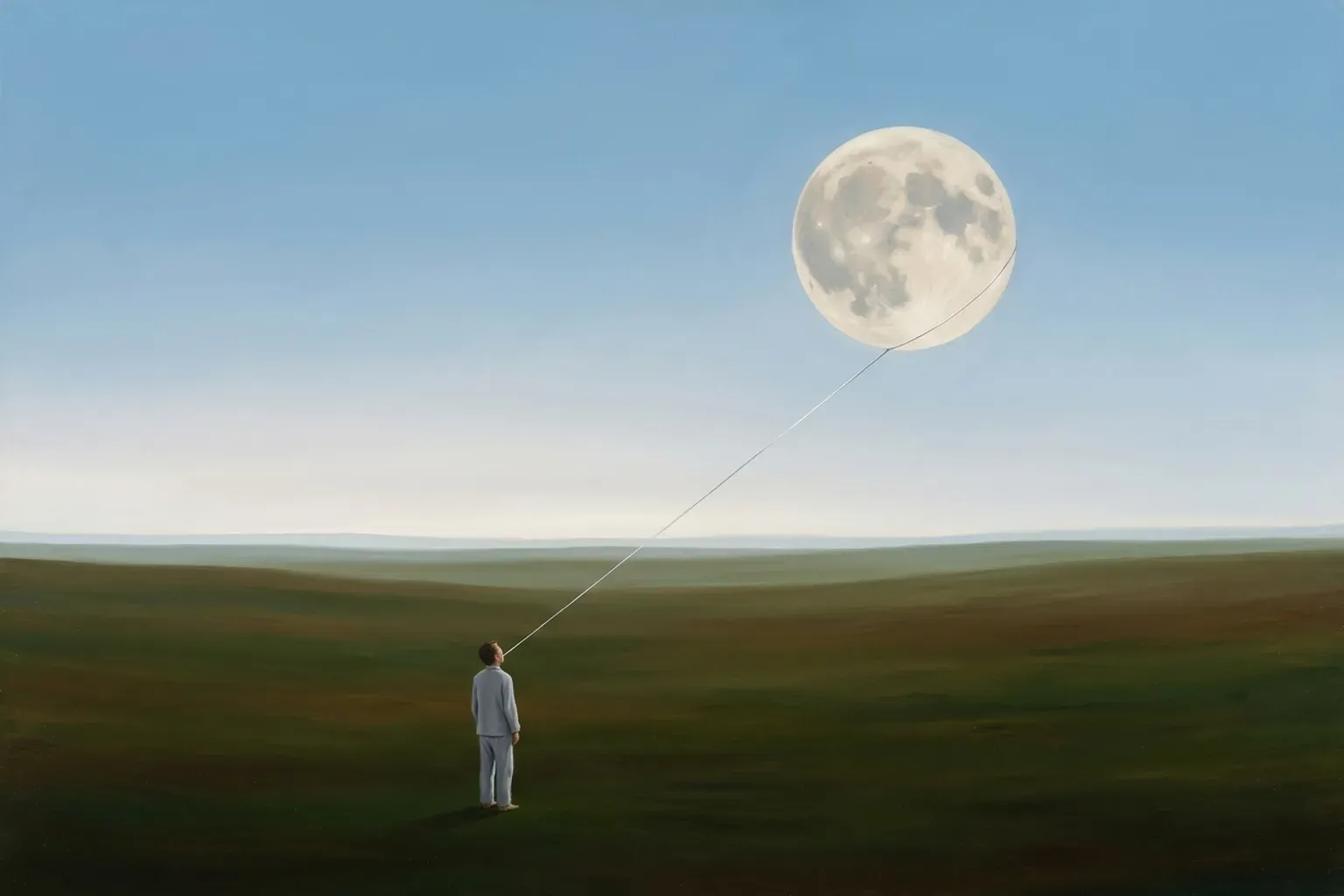
You wake up from a vivid dream.
There was a hotel, or maybe a hospital. Someone you haven’t thought about in years was there. Something happened with a train. For some reason the moon was enormous.
It all feels perfectly clear.
Then you check the time.
And half of it is gone.
You try to reconstruct what happened, but now you’re reconstructing the memory of remembering the dream. A few minutes later you’re left with something like: train, Anna, weird moon, felt important.
Dreams are annoyingly good at disappearing.
This is why I think voice is one of the best ways to capture them.
Don’t write. Talk.
A voice dream journal is exactly what it sounds like: instead of sitting up and writing a coherent journal entry, you start talking while the dream is still there.
It doesn’t need to sound good.
Actually, it probably shouldn’t.
Hotel. Anna was there. No, not Anna. Looked like Anna. We were waiting for a train. Everything outside was red. I couldn’t find my shoes. There was something about the moon…
That’s already a perfectly good dream entry.
The goal at this point isn’t writing.
It’s retrieval.
You can turn it into something readable later. Right now you’re just trying to pull as much of the dream as possible across that strange border between sleeping and waking.
Why voice works so well in the morning
Keeping a notebook next to your bed is great advice.
In theory.
In practice, you wake up at 4:17 a.m., you’re barely conscious, one arm is asleep and writing three pages about an underground city you’ve just escaped from is not particularly appealing.
Typing is easier, but it still requires looking at a screen and becoming awake enough to operate a tiny keyboard.
Talking has much less friction.
You can keep your eyes closed. You don’t need complete sentences. You don’t need to decide whether something is important enough to write down.
You just say what you remember.
Dream journalers have been using voice recorders for exactly this reason for years: speed and convenience immediately after waking. Some prefer writing later, but use voice to make sure the original dream isn’t lost first. In one small comparison study, voice-recorded dream reports came out substantially longer than written ones, though writing kept advantages of its own once you’re organizing and rereading. [1]
There’s another advantage I’ve noticed: speaking seems much more compatible with the shape of dream memory.
Dreams don’t usually come back as prose.
They come back as fragments.
A face.
A room.
A feeling.
Something impossible that somehow seemed completely normal.
When you force those fragments into sentences too early, you’re already editing the dream.
This isn’t just a feeling. In a large diary study where people recorded the same dreams both ways for two weeks, the report medium affected how the dream experience was represented, and written reports tended to lose some of the dream’s perceptual detail. [2]
Voice lets you follow them around instead.
How I would record a dream
The important part is to start before your brain gets interested in everything else. (In Lunar Log, voice journaling is a single press, and the recording is kept alongside the words.)
Before messages. Before Reddit. Before figuring out what day it is.
If you wake up remembering something, stay still for a moment.
Start with whatever is clearest.
It doesn’t have to be the beginning.
In fact, the end is often easier.
Say it out loud:
I was standing outside my old school.
Then ask yourself what happened immediately before that.
Before that I was inside with someone.
Who?
I think it was Tomas. Or someone who felt like Tomas.
What did the place look like?
How did you feel?
What was strange?
Keep pulling on whatever thread appears.
If another completely unrelated fragment suddenly comes back, record that too. Don’t worry about chronology.
Something as simple as:
blue room, my sister, couldn’t open the door, very calm, dog outside
is infinitely more useful than recording nothing because you couldn’t reconstruct the whole dream.
You can clean it up later.
And if nothing comes back at all, I’ve written separately about how to remember your dreams.
Capture first. Interpret later.
I think this distinction is important.
When recording a dream, I wouldn’t immediately start asking what everything means.
If you dream about a snake, don’t stop halfway through remembering the dream to decide whether the snake represents transformation, sexuality, fear, kundalini, your boss, or the fact that you watched a documentary about snakes yesterday.
First record the snake.
Record what it looked like.
What it did.
How you felt about it.
Where you were.
What happened next.
Interpretation is a different activity.
Mixing the two makes it surprisingly easy to replace what you actually dreamed with the story you’re constructing about it.
Capture first. Make sense of it later.
Voice vs typing vs handwriting
There isn’t one correct way to keep a dream journal.
They solve slightly different problems.
| Method | Great for | Not so great for |
|---|---|---|
| Voice | Capturing a lot while half-asleep | Reviewing raw recordings later |
| Typing | Search, organization and editing | Tiny keyboards at 4 a.m. |
| Handwriting | Slow reflection and intentional journaling | Capturing a disappearing dream quickly |
I don’t think voice needs to replace writing.
The combination I like is:
Voice first. Structured journal second.
Capture the messy thing while it exists. Let transcription turn it into text. Later, when you’re actually awake, fix names, add context or write down what you think it meant.
You get the speed of a voice recorder without ending up with three years of mysterious audio files called Recording 274.m4a.
What should a good voice dream journal actually do?
The obvious version is just a voice recorder.
Press record. Talk. Done.
But once you’ve recorded a few hundred dreams, the interesting problem changes.
You don’t just want to store them anymore.
You want to find them.
When did I last dream about this place?
Why does this person keep appearing?
Was there another dream with that same staircase?
Do I dream about the ocean more when I’m stressed?
Have my dreams changed over the last year?
That’s when a pile of recordings becomes frustrating.
A useful dream journal should be able to turn speech into searchable text while preserving what you originally recorded. It should let you connect recurring people and places, track themes and emotions, find old dreams, and get your data back out whenever you want it.
And because dreams can contain some of the most private material you’ll ever write down, privacy shouldn’t be an afterthought.
This is basically the problem we’re building Lunar Log around.
You can speak or type a dream, tag people and places as naturally as @Mom or @the beach, and gradually build a connected history of your dream life.
The interesting part isn’t any single entry.
It’s what happens when there are hundreds of them.
A simple voice dream journal routine
You don’t need much of a system.
Before sleeping: have whatever you’re going to record with ready.
When you wake: don’t immediately start consuming information. If there’s a dream there, catch it.
While recording: fragments first. Details second. Don’t worry about making sense.
Later: fix the transcription, add anything that returned to you, tag important people or places.
Every once in a while: look backward.
That last part is where dream journaling gets strange and interesting.
You find places you were sure you’d only dreamed about once.
People disappear for months and return.
A completely ordinary object turns out to have appeared nine times.
Sometimes the pattern means something.
Sometimes your brain apparently just really likes elevators.
Both are worth knowing.
Does voice recording count as dream journaling?
Of course.
A dream journal isn’t defined by the object you put the dream into.
Notebook, phone, voice recorder, computer: the useful habit is remembering and recording dreams consistently enough that they don’t simply disappear.
If speaking makes you more likely to record a dream, speak.
If handwriting makes you remember more, write.
If you want to mumble five keywords into your phone at 3 a.m. and turn them into a proper entry over coffee, that’s fine too.
The best dream journal is the one you’ll actually use when you’re barely awake.
Can voice journaling help with lucid dreaming?
Dream journaling is commonly used by lucid dreamers for two reasons.
First, there’s not much point becoming lucid if you don’t remember it the next morning.
Second, keeping a history of dreams makes recurring dream signs easier to notice.
Maybe you’re constantly back at school.
Maybe elevators never work properly.
Maybe dead relatives casually show up for dinner.
Recognizing those patterns while awake can make them easier to recognize while dreaming.
Voice doesn’t fundamentally change that practice. It just removes some of the friction from recording the dreams in the first place.
And less friction usually means more dreams actually make it into the journal. Some research points the same way: dream recall measured with daily logs tends to be higher than people’s retrospective estimates suggest, and keeping a log may itself improve recall, though findings aren’t completely uniform. [3]
A note about privacy
Dream journals are weirdly intimate things.
They contain relationships, sex, fears, people you know, things you’re ashamed of, things you don’t understand, and occasionally things you’d rather not explain to anyone at all.
That makes me uncomfortable with the idea that a dream journal should automatically become somebody else’s cloud data.
It’s one of the reasons Lunar Log is being built local-first.
You should be able to keep a dream journal on your own device, offline, without creating an account. If you want synchronization or AI features, those can be choices rather than prerequisites.
Your dreams shouldn’t be the price of admission.
Start with whatever survived
If you want to try voice dream journaling tomorrow morning, don’t make it complicated.
When you wake up, don’t try to remember everything.
Find one thing that survived.
A person.
A place.
An image.
A sentence.
A feeling.
Say it out loud.
Then see what comes back.
Dream memory is peculiar. Sometimes one tiny detail opens the door to an entire sequence you thought you’d already lost.
And if all you get is:
giant moon, train station, couldn’t find shoes
keep that.
Tomorrow there might be more.
Lunar Log is a private, local-first dream journal for iOS, Android, and the web. Capture dreams by voice or text before they fade, then explore the people, places, symbols and patterns that recur over time. It’s free to journal, forever. Get the app.
Sources & further reading
- Schredl M, Dreer J, Mösle A, Rall M, Rauch L, Rose S, Seuffert S. Voice-recorded vs. written dream reports: A research note. International Journal of Dream Research, 2019;12(1):138–140.
- Casagrande M, Cortini P. Spoken and written dream communication: differences and methodological aspects. Consciousness and Cognition, 2008;17(1):145–158. (PubMed)
- Aspy DJ. Is dream recall underestimated by retrospective measures and enhanced by keeping a logbook? An empirical investigation. Consciousness and Cognition, 2016;42:181–203. (PubMed)